

In the April post Get A Mortgage From The Option Market we dove into using a box spread to borrow at the rate baked into SPX options, no bank required.
This week I had some cash to park and noticed a convo on twitter suggesting box spread rates should be extra wide over T-bills right now because the demand for leverage leaks into the derivatives funding. So I took a closer look and indeed decided to lend via options.
[Once I start building the ADU, I’ll be on the other side needing to borrow, in which case I hope the funding spread relaxes.]
So today will be highly hands-on as we:
- Read the SPX box-implied yield curve on boxtrades.com — and pull actual prints so you can see where boxes are really trading, not just where they’re quoted
- Compute sizing
- Watch over my shoulder as we build the box leg by leg in IBKR’s Strategy Builder
- See how the price maps to a yield
- Submit the order and interpret the rate of the fill
I recorded a screen-share video doing exactly this with my own cash, so you can just follow along.
We also dive into the tax treatment at both the state and federal levels and how the classifications differ.
The box rate yield curve
First, notice the box rate yield curve:
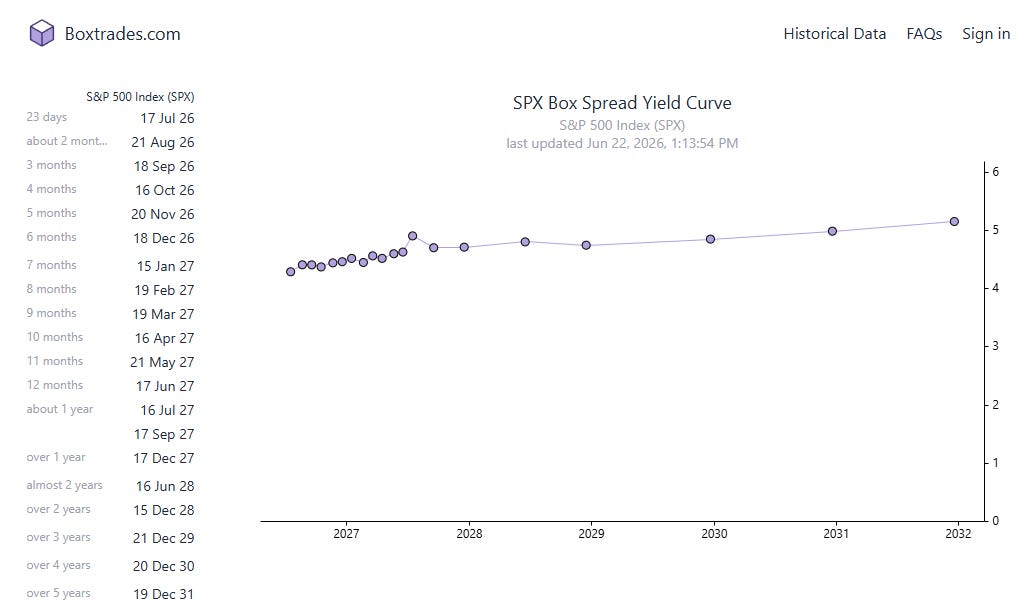
4.80% 1-year out and as you’ll see later, the tax rate is pretty nice even for short-term holds.
I’ll just mention this. I remember an old interview with Jeremy Grantham of GMO where he explained that the dot-com bubble was more painful for professional money managers than it was for retail as the pros needed to chase returns because of benchmarks. The pros were better at anticipating 2008 but they were the fish in 2000.
This interview occurred in the late 2010s ZIRP/TINA era. Jeremy found the 2000s pain to be a bit of an own-goal. People were paying prices that implied horrible forward returns, meanwhile you could pick up a RFR north of 5%. If the implied equity risk premium wasn’t inverted (ie negative), it was close.
It’s clearly much easier to say this in hindsight. In the moment, the managers needed to chase. Value investors couldn’t raise their heads out of the foxhole without being ridiculed for their dowdy ways. Imagine today’s boomers telling the Greatest Generation to get with the program.
Just like back then, I’m not sure how much you’re supposed to be hiding. I don’t know if all the issuance will mark the top. I don’t know if the public markets will affirm the prices set in the one-way auctions of the private markets where the most enthusiastic bid sets the level. But we’re gonna find out. And if the snake of passive investing can’t open its jaws wide enough to take down the VC’s bags we won’t be able to say there was no alternative.
That’s enough boogie man stuff from the recesses of my lizard brain.
Less talk, more doing
It’s easier to show than tell:
What about taxes?
SPX options are Section 1256 contracts, so the box profit gets 60/40 treatment automatically: 60% long-term, 40% short-term, regardless of how long you hold it.
T-bill interest is just ordinary income, but it’s exempt from state tax. You’ve got two offsetting forces so how does this cash out?
Start with the worst-case marginal rates:
Top federal bracket
+ the 3.8% NIIT
+ plus California at 13.3% (which gives capital gains no break and taxes them like ordinary income)
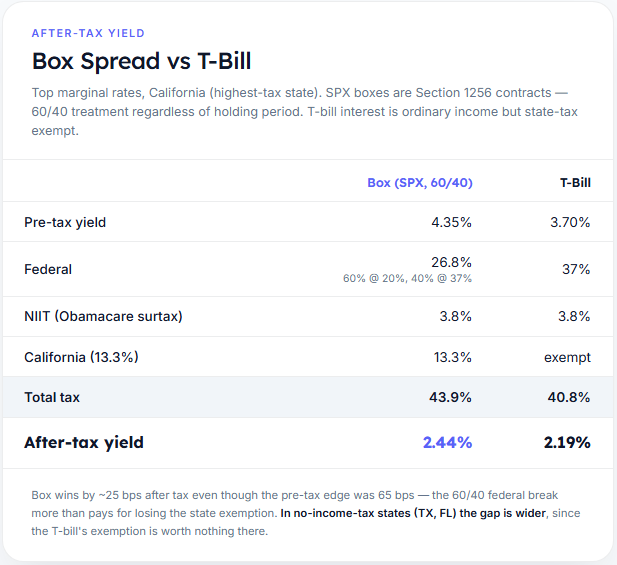
On the box, the federal piece blends to 26.8% (60% taxed at 20%, 40% taxed at 37%). Add the 3.8% NIIT and California’s 13.3% and you’re handing back 43.9%.
A 4.35% box nets you 2.44% after tax.
On the T-bill, you owe 37% federal plus the 3.8% NIIT, but zero to California. That’s 40.8% total. A 3.70% T-bill nets you 2.19% after tax.
So the box wins by about 25 basis points after tax even though the pre-tax edge was 65.
The 60/40 federal treatment more than pays for losing the state exemption, even in the highest-tax state in the country. Live somewhere with no income tax and the gap only gets wider, since the T-bill’s state exemption is worth nothing to you there anyway.
In addition, the box profit is a capital gain which you can offset with capital losses, harvested or otherwise, washing the box gain dollar-for-dollar, at both the federal and California level. Meanwhile, T-bill interest is classified as ordinary income. So if you’ve got a loss inventory sitting around, the box’s effective after-tax yield is even better than 2.44%.
The option market will lend your money out at a better rate, and give most people a better tax wrapper as well.
Summary of tax:
If you need a review of what boxes are and risks you can follow the links embedded in this: Get A Mortgage From The Option Market